S04005 is a temporary designation that appeared on the Minor Planet Center NEO Confirmation Page (NEOCP). This update preserves the original observational documentation from 12 October 2026 and adds the 13 and 16 October follow-up, the evolving MPC orbital solutions, and an independent cross-check from the Las Cumbres Observatory NEOexchange portal. The status described here is a snapshot as of 16 October 2026: S04005 is still shown as a candidate, not as a definitively confirmed discovery.
1. Initial observation and first S04 tracklet
On the night of 12 October 2026, the Narciso Spuntoni Astronomical Observatory (MPC S04) measured a moving object against the stellar background. The image below is the original observational figure published in the 13 October article and is intentionally preserved unchanged.
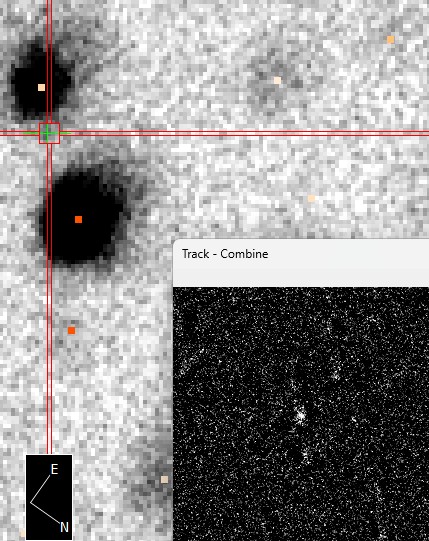
The first S04 ADES XML contained six astrometric positions. The times, coordinates and magnitudes of this initial sequence remain those documented in the previous version of the article:
| UTC | RA (deg) | Dec (deg) | V (mag) |
|---|---|---|---|
| 22:46:49.152 | 314.68687500 | +47.75388889 | 20.65 |
| 22:50:26.016 | 314.69229167 | +47.75147222 | 20.55 |
| 22:54:17.568 | 314.70229167 | +47.74713889 | 20.62 |
| 22:57:53.568 | 314.70770833 | +47.74525000 | 20.64 |
| 23:01:14.016 | 314.71583333 | +47.74261111 | 20.57 |
| 23:04:35.328 | 314.72279167 | +47.74005556 | 20.63 |
The apparent sky motion derived from the first sequence was about 5.7 arcsec/min, toward the southeast at position angle approximately 120°. This is a projected angular rate on the sky; it does not by itself determine geocentric distance or orbital class.
2. Follow-up on 13 and 16 October: extending the observed arc
S04 follow-up continued with six positions on 13 October (internally labelled Track 368) and five positions on 16 October. The MPC observation listing viewed on 16 October therefore showed 17 S04 positions across three nights. The public orbital-solution table, however, showed NObs = 12, an arc of about 3 days, and a nominal RMS close to 1.30 arcsec.
The public material reviewed does not identify which five of the 17 displayed positions were excluded or not counted in that specific fit. For that reason, the quoted RMS is not assigned indiscriminately to all 17 measurements. This distinction matters: the number of published measurements and the number of observations used by a specific orbit solution are not necessarily identical.
3. Why a short-arc orbit can change rapidly
A short astrometric tracklet constrains sky direction and angular motion very well, but distance, radial velocity and orbital curvature remain strongly correlated. Additional observations separated in time can therefore shift a nominal orbit substantially. S04005 provides a clear example of this short-arc degeneracy being progressively reduced.
| Snapshot | a (AU) | e | i | Derived q (AU) | Derived Q (AU) | Conditional nominal class |
|---|---|---|---|---|---|---|
| 12 October | 0.997120 | 0.177924 | 4.11986° | 0.81971 | 1.17453 | Aten |
| 13 October | 1.785306 | 0.658763 | 11.7513° | 0.60921 | 2.96140 | Apollo |
| 16 October | 1.0991188 | 0.3688955 | 7.48222° | 0.69366 | 1.50458 | Apollo |
The transition from an initially Aten-like nominal solution to Apollo-type solutions does not mean that the physical orbit changed within a few days. It means that our estimate of the orbit changed as the fit received a longer time baseline. This is expected behaviour for candidate NEOs determined initially from short arcs.
4. MPC nominal solution on 16 October
The nominal solution displayed on 16 October is characterized by the following osculating elements:
| Element | Value |
|---|---|
| Semimajor axis a | 1.0991188 AU |
| Eccentricity e | 0.3688955 |
| Inclination i | 7.48222° |
| Longitude of ascending node Ω | 316.59723° |
| Argument of perihelion ω | 314.14127° |
| Mean anomaly M | 63.58932° |
| Epoch | K26AD / MJD 61326.0 (13 October 2026) |
| Perihelion q = a(1−e) | ≈ 0.69366 AU |
| Aphelion Q = a(1+e) | ≈ 1.50458 AU |
| Derived Keplerian period | ≈ 420.9 days (1.152 years) |
| Reported nominal RMS | ≈ 1.30 arcsec |
Under the MPC/CNEOS definitions, an orbit with a ≥ 1 AU and q < 1.017 AU is Apollo-type. With q ≈ 0.694 AU, the 16 October nominal solution meets that criterion. The classification remains provisional, because it still depends on a short-arc solution.
5. Convergence of variants: useful information, but not a confidence region
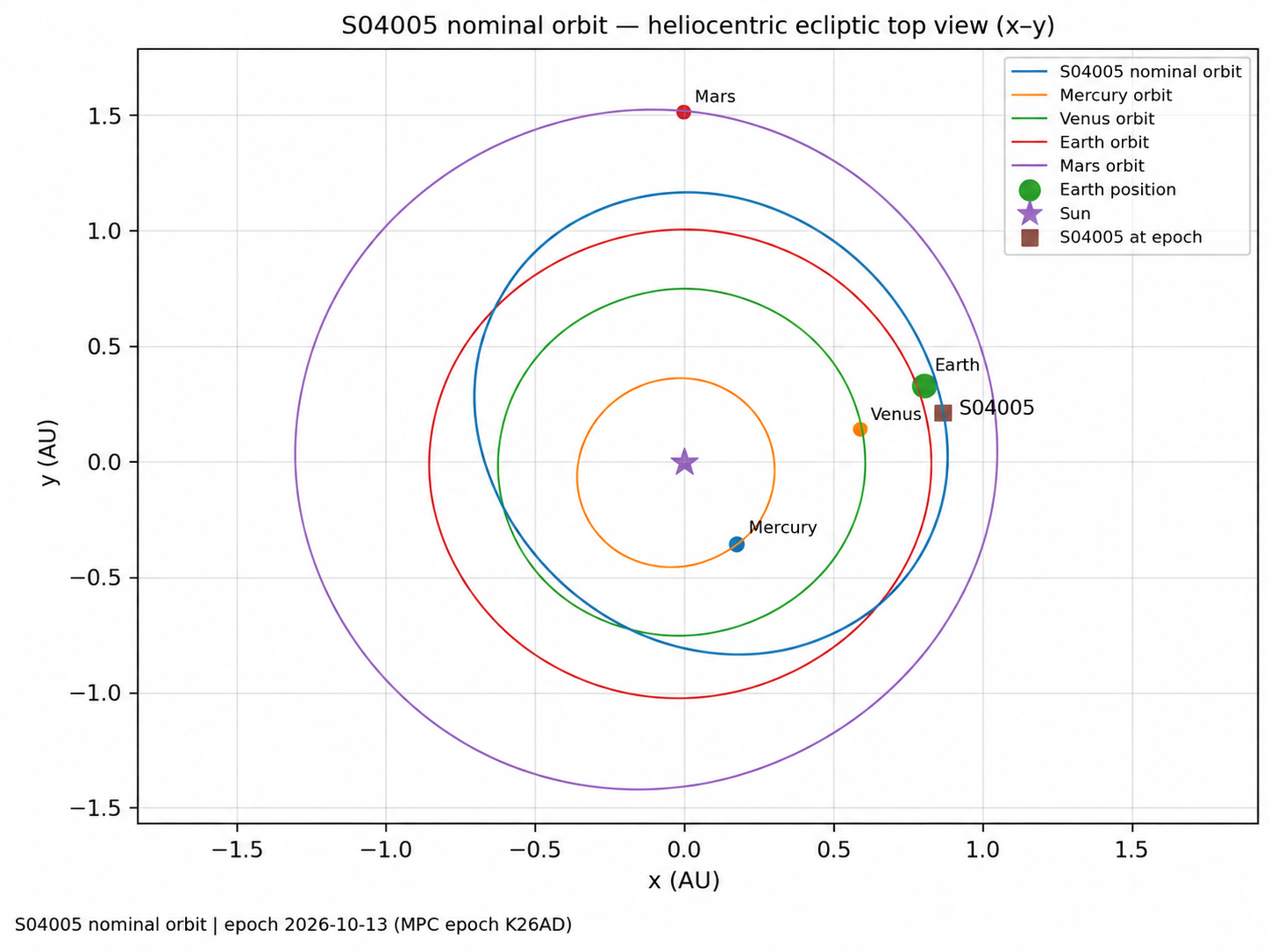
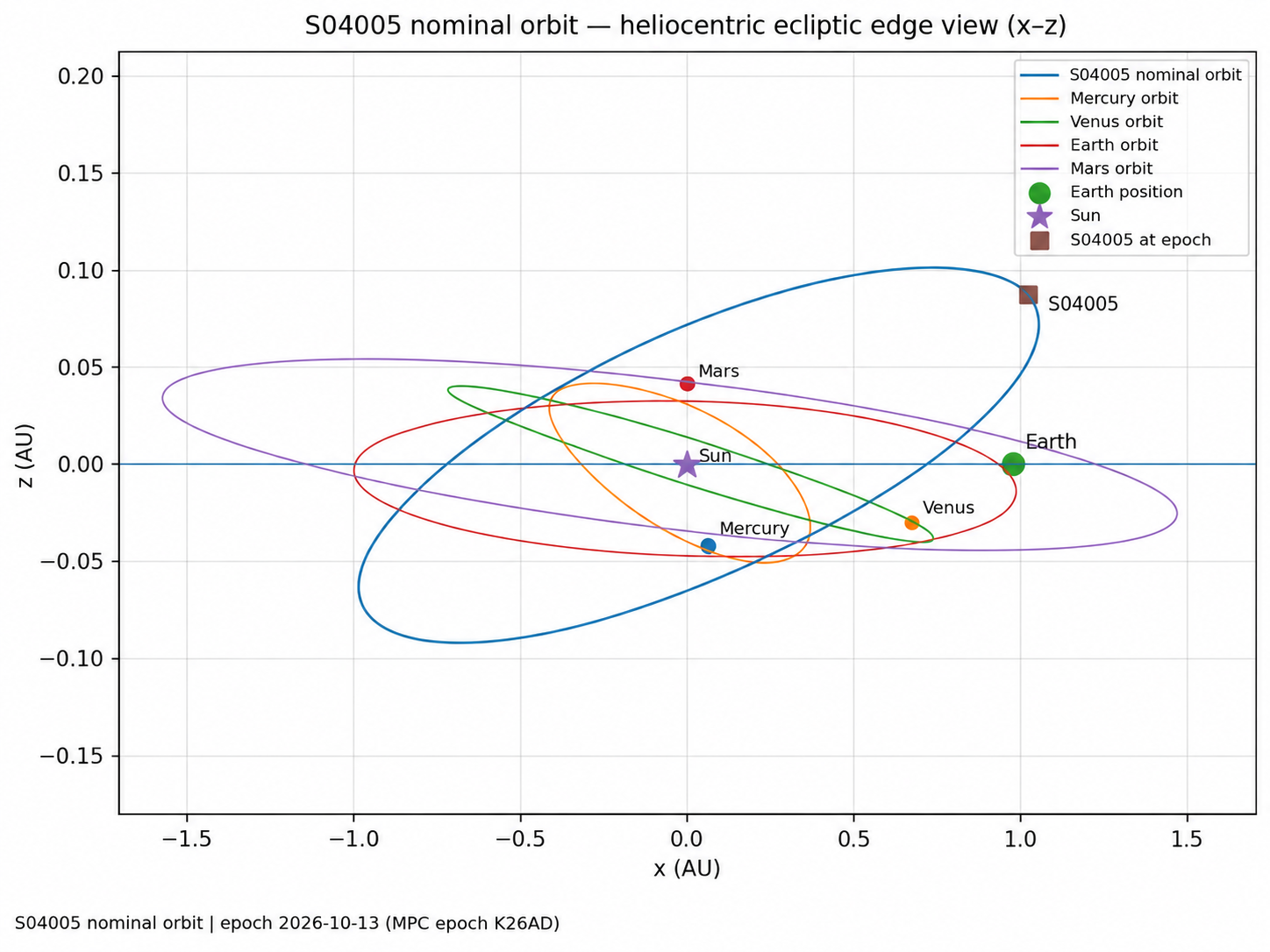
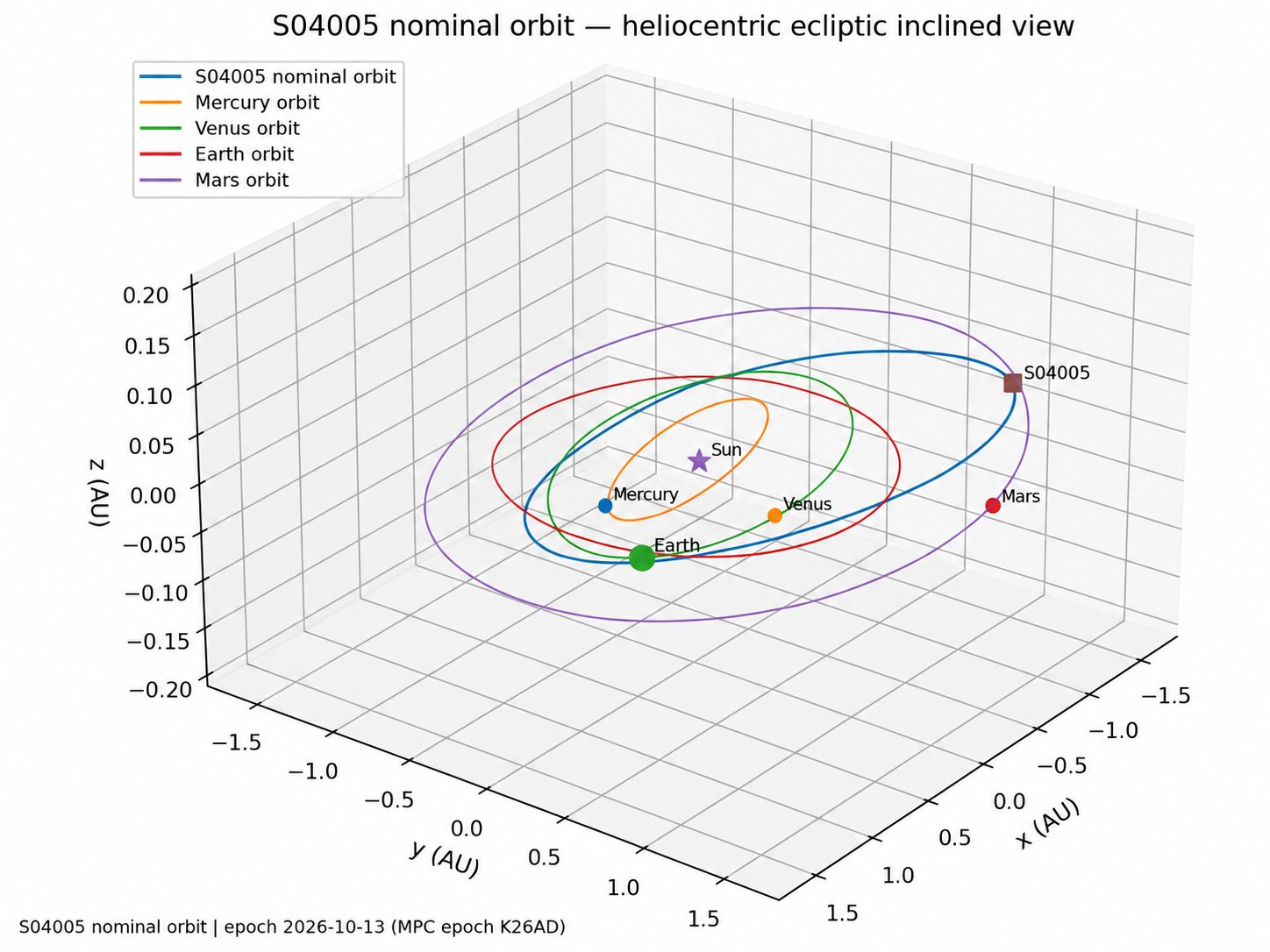
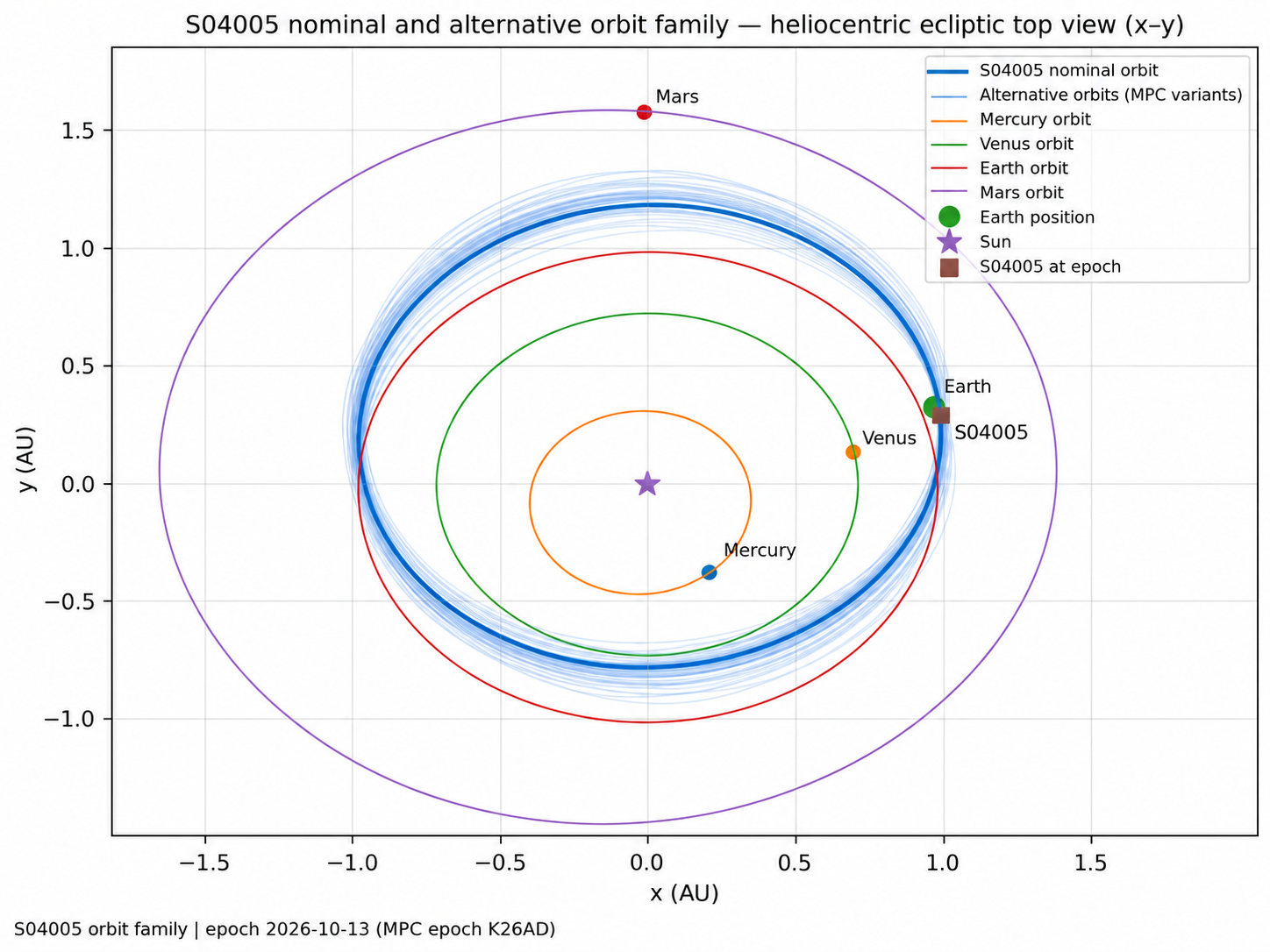
The MPC variants supplied for 16 October appear visually and numerically more tightly grouped than the earlier solution snapshots. As an example, variants V0001–V0005 in the supplied working material cluster at approximately a = 1.0745–1.0903 AU, e = 0.3387–0.3586 and i = 7.00–7.32°, with RMS values around 1.27–1.28 arcsec.
This tightening is consistent with improved geometric constraint from the longer observed arc. It should not, however, be interpreted as a calibrated 1σ/3σ statistical interval or as a probability distribution. A rigorous uncertainty analysis would require the covariance of the fitted orbit or an explicitly constructed orbit sample based on observational uncertainties and a stated dynamical model.
Top view — x–y plane
Edge view — x–z plane
Inclined 3D view
Nominal and family of variants
6. Independent cross-check: Las Cumbres Observatory — NEOexchange
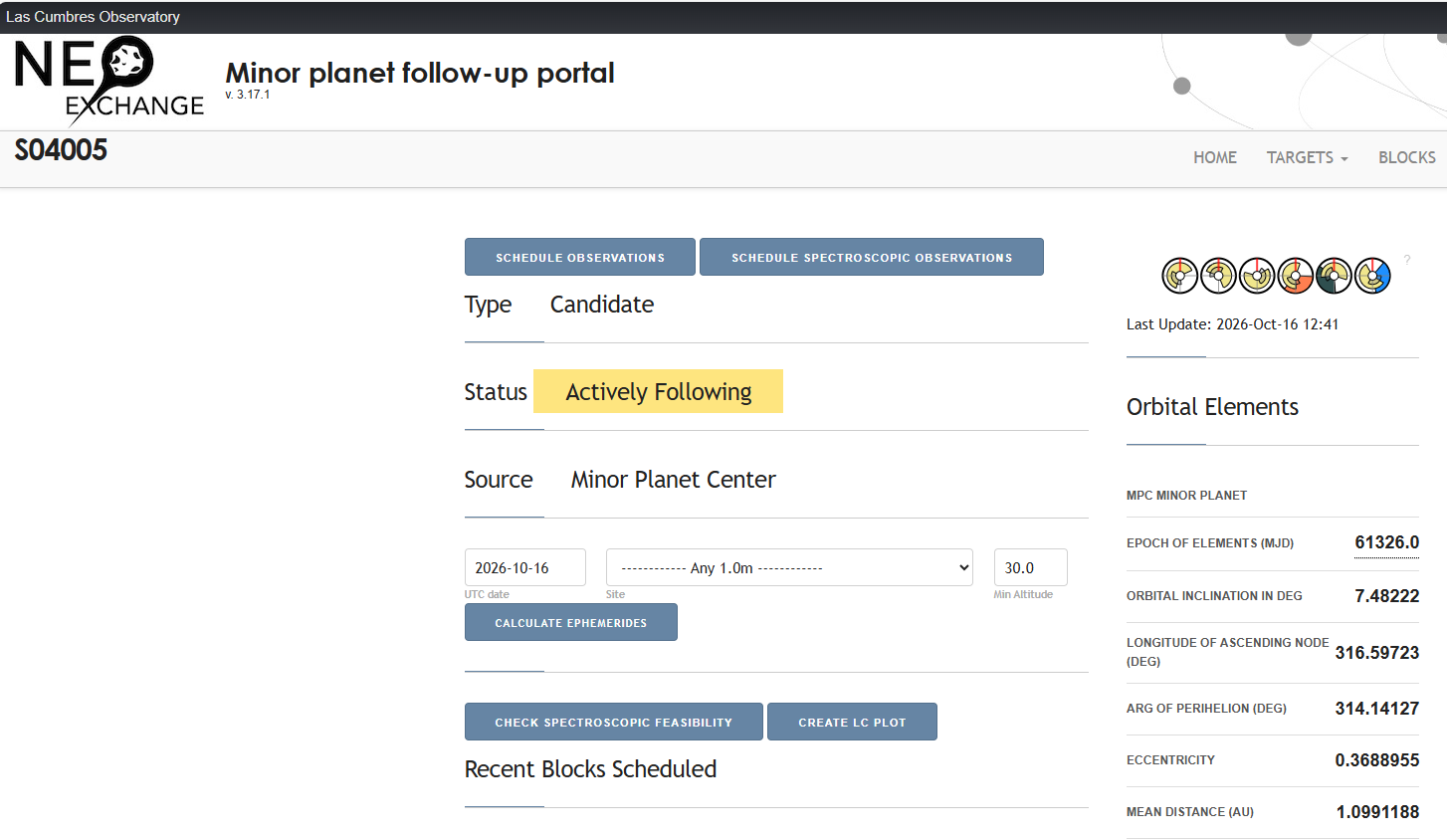
The Las Cumbres Observatory NEOexchange portal lists S04005, in the snapshot updated on 16 October 2026 at 12:41, as Type: Candidate, Status: Actively Following, and Source: Minor Planet Center. Its displayed elements match the MPC nominal solution quoted above: a = 1.0991188 AU, e = 0.3688955, i = 7.48222°, epoch MJD 61326.0.
The same page reports 12 observations, an arc of 3.08 days, H = 22.6, and digest2 = 100. No LCO blocks were listed in the Recent Blocks Scheduled section at the time of the captured snapshot. This is a useful independent status cross-check, but it does not replace a definitive orbital solution.
7. Absolute magnitude and size estimate: what H = 22.6 means
NEOexchange reports H = 22.6 and a mean diameter estimate around 107 m, with a wide illustrative range driven by the assumed albedo. This is not a direct diameter measurement: converting H to size is strongly dependent on surface reflectivity. Without an independent albedo, thermal-radiometric, or radar constraint, the quoted diameter should be treated as a model-dependent estimate, not as a measured physical size.
8. What the present data do and do not establish
- They do establish that S04005 was astrometrically followed over three nights, that the time baseline increased, and that the MPC nominal solution changed substantially before settling, as of 16 October, on parameters consistent with an Apollo-type nominal orbit.
- They show that the variants supplied for 16 October are more closely grouped, a behaviour consistent with improved orbital constraint.
- They do not establish an Earth minimum distance, a reliable MOID, an impact probability, or PHA status from these plots alone.
- digest2 = 100 is not 100% confirmation: digest2 is a short-arc tracklet classifier designed to prioritize follow-up.
- The quoted orbital RMS cannot be assigned to all 17 measurements unless the exact set of 12 observations entering the published fit is known.
9. Next scientific checks
Further independent astrometry, individual topocentric O−C residuals, explicit reconstruction of the observations included in the orbit fit, and — once a sufficiently stable orbit/covariance is available — numerical propagation with a stated dynamical model would provide the next level of analysis. Only then would it be appropriate to discuss close-approach distances, future uncertainty, or Earth-encounter geometry quantitatively.
Scientific references and data links
- Minor Planet Center — NEO Confirmation Page.
- Minor Planet Center — S04005 observations.
- Minor Planet Center — S04005 orbital solutions.
- Las Cumbres Observatory — NEOexchange: S04005.
- MPC Documentation — Initial Orbit Determination with digest2.
- MPC Documentation — Orbit Type Definition.
- MPC Documentation — Minor-Planet Orbit Format.
- MPC Documentation — ADES Data Submission.
- MPC Documentation — MPC Software: digest2, mpc_orb and ADES.
- NASA/JPL CNEOS — NEO Basics and orbital groups.
- Keys, S. et al. (2019), The digest2 NEO Classification Code, PASP 131, 064501 — DOI 10.1088/1538-3873/ab1157.
- Minor Planet Center — MPC Newsletter, December 2023.
Credits and acknowledgements
Text and astrometric observations: L. S. Spuntoni, Narciso Spuntoni Astronomical Observatory (MPC S04). Orbital data and solutions: Minor Planet Center. NEOexchange status and summary data: Las Cumbres Observatory. Figure 1: original S04 observational image already published in the 13 October article and intentionally preserved. Figures 2–5: illustrative visualizations supplied for Spuntosoft Research from MPC parameters and working material; they must not be used as precision ephemerides or confidence regions. Figure 6: LCO NEOexchange screenshot reproduced for documentation. Thanks to the MPC and LCO for their public services supporting collection, publication and follow-up of NEO candidates.