In the constellation Cancer lies one of the most fascinating and scientifically important deep-sky objects: the star cluster M67. At first sight it may look like a simple concentration of stars, but closer examination reveals a natural laboratory for the study of stellar evolution.
Video 1. The video presents a three-dimensional reconstruction of the M67 field obtained by associating stars in the image with an estimate of their distance along the line of sight. The photographic plane is shown as a vertical surface, while horizontal segments connect identified stars to their positions in the reconstructed volume. Distance is represented on a logarithmic scale, allowing relatively nearby and much more distant objects to be shown together while strongly compressing their true separations. The sequence therefore highlights that an astronomical photograph is a two-dimensional projection of sources at different distances and that not every star visible in the same field physically belongs to the cluster. The concentration of objects at distances compatible with M67 helps distinguish the cluster core from foreground and background field stars. The reconstruction should be interpreted as a scientific visualization of depth rather than as a rigorously scaled geometric model, because astrometric uncertainties and the logarithmic transformation necessarily alter proportions along the distance axis.
Star clusters are groups of stars gravitationally bound and born from the same cloud of gas and dust. Their stars therefore share approximately the same age and a similar chemical composition, making clusters fundamental tools for understanding how stars form and evolve. Two main classes are commonly distinguished: open clusters, generally younger, less dense and located in the Galactic disk, and globular clusters, much older, compact and distributed through the Galactic halo.
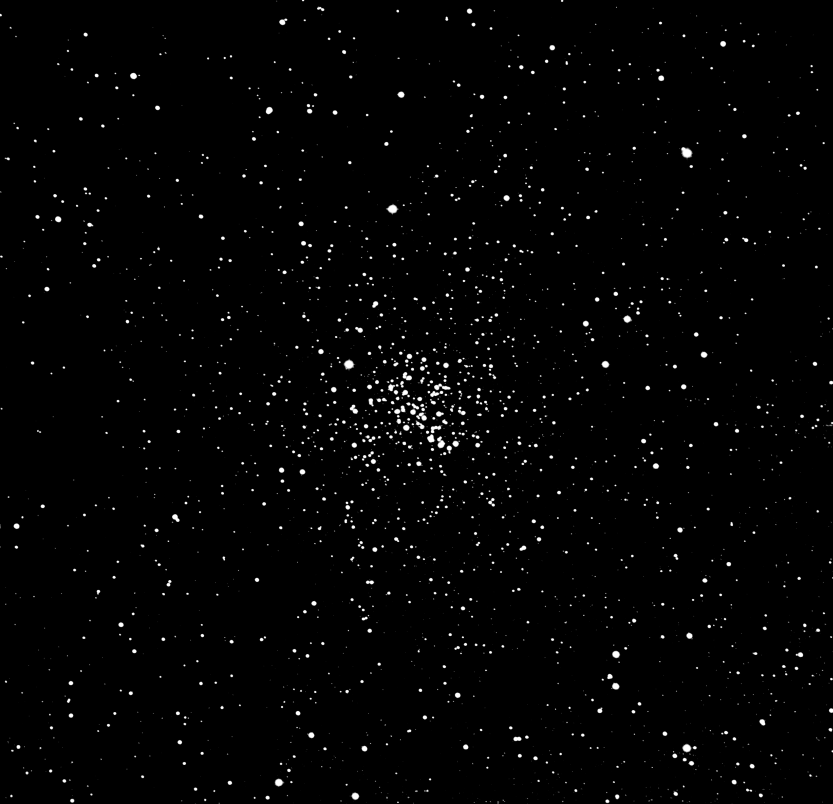
Fig. 1. The image shows the M67 star field without graphic overlays. The greater stellar density in the central region makes the cluster immediately recognizable, while toward the edges the distribution becomes progressively sparser and merges with the Galactic field-star population. Stars of very different apparent brightness are visible, reflecting both cluster members in different evolutionary stages and unrelated sources projected along the same line of sight at different distances. The central concentration is consistent with the cluster’s long dynamical evolution: gravitational interactions tend to make the core more compact while some stars migrate toward the outskirts or are dispersed into the Galactic field. The image alone cannot establish membership of each star with certainty; astrometric information such as proper motion and parallax, together with photometric or spectroscopic data, is required.
M67 belongs to the class of open clusters, but it is a particularly unusual example. It is one of the oldest known open clusters, with an estimated age of about four billion years, comparable to that of the Sun. This makes it especially valuable because it contains stars in evolutionary stages broadly comparable with those relevant to our own star.
Located about 2,600 light-years from Earth, M67 lies relatively close to the plane of the Milky Way but in a region where gravitational perturbations are less disruptive, a condition that has favoured its unusually long survival for an open cluster. Images reveal a rich and complex structure, with a strong central concentration of stars and a progressively sparser outer distribution, reflecting the continuing effect of stellar interactions and the Galactic gravitational field.
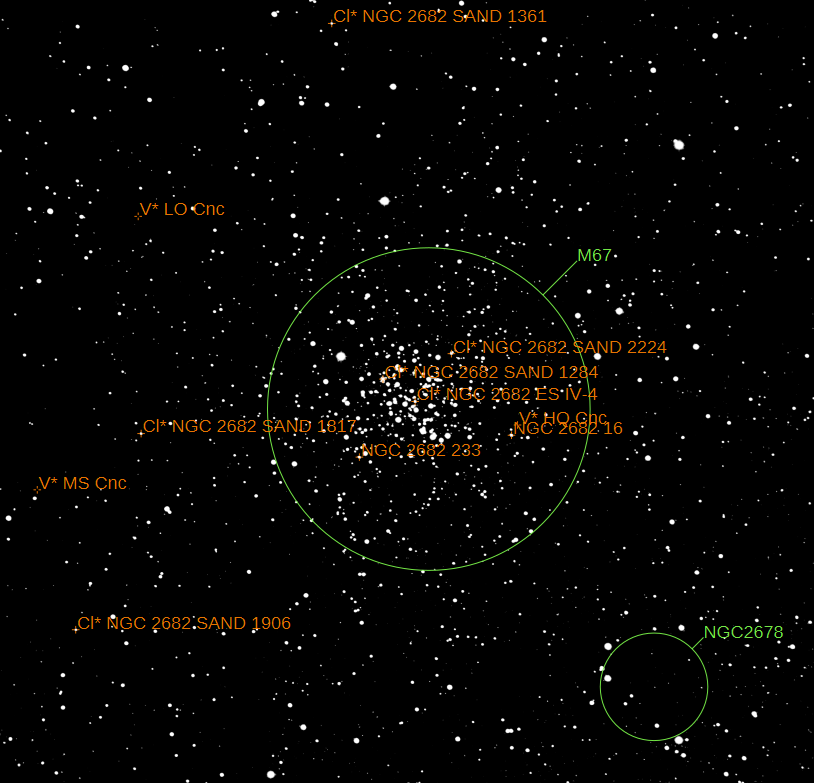
Fig. 2. The annotated version identifies the main region of M67 with the large green circle and marks, in the same field, the stellar concentration labelled NGC 2678. Orange labels identify selected catalogue sources and objects of particular interest, including SAND-series stars, variable stars and candidates with unusual evolutionary properties. Their positions relative to the cluster centre show that the studied objects are not confined to the densest core: some lie in the outer regions, where field-star contamination becomes more important and cluster membership must be tested with astrometric criteria. The figure is also useful for planning photometric observations because it shows the spatial distribution of targets and possible comparison stars in the same field. The annotations indicate catalogue identifications and projected positions on the sky; by themselves they do not imply that all labelled objects are at the same distance or are dynamically secure members of M67.
M67 contains a remarkable variety of stellar populations. Numerous Sun-like stars make the cluster an important reference for studies related to our own star. It also contains red giants, evolved stars that have exhausted hydrogen in their cores, and white dwarfs, the final remnants of stars with masses similar to the Sun. Binary systems and variable stars are also present, and their observation can provide important information about mass, luminosity and internal stellar structure.
Particularly interesting are the so-called Blue Stragglers, anomalous stars that appear younger and hotter than the rest of the cluster population. Their presence is probably linked to stellar mergers or interactions and remains an active field of research. Several variable stars have also been identified in M67, some of which are useful for investigating the cluster’s physical and dynamical properties.
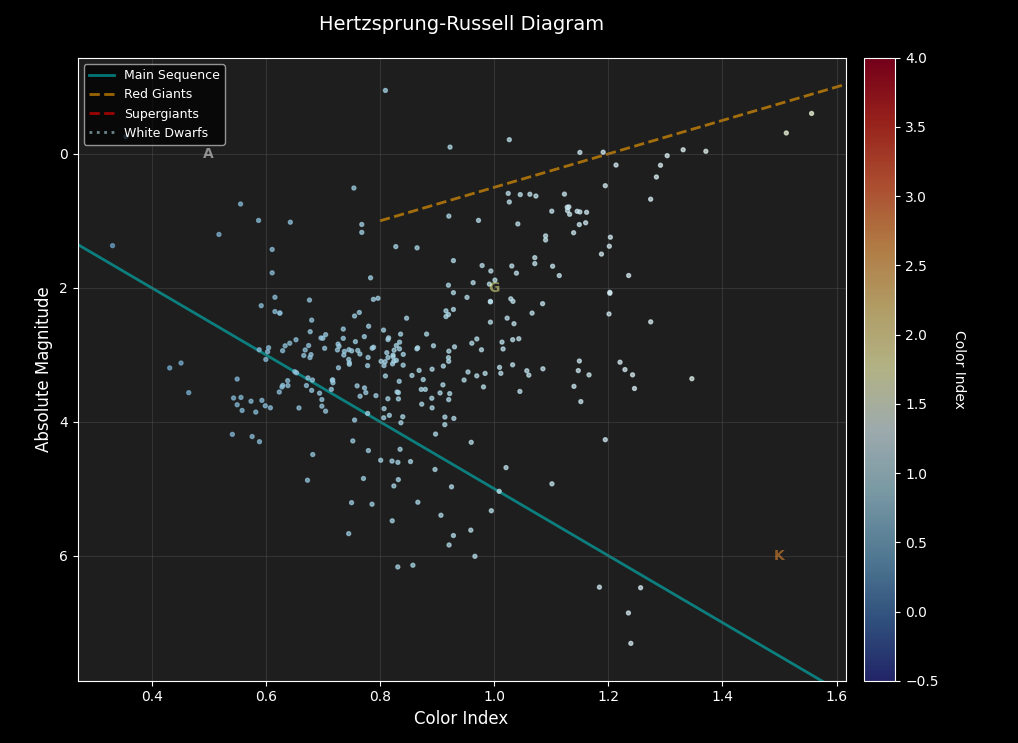
Fig. 3. The Hertzsprung–Russell diagram represents stars using colour index on the horizontal axis and absolute magnitude on the vertical axis, with the most luminous objects placed higher. The main stellar distribution traces the cluster’s evolutionary sequence: the main sequence is visible in the central region, while the point at which it turns toward redder colours and greater luminosity is the turn-off, where the most massive stars still present are exhausting hydrogen in their cores. The branch extending upward to the right contains subgiants and red giants. Objects bluer and brighter than the turn-off are possible Blue Stragglers, while fainter and more scattered sources may include field stars, unresolved binaries or measurements with larger uncertainties. The Main Sequence, Red Giants, Supergiants and White Dwarfs lines are schematic guides and do not replace a theoretical isochrone calculated for the specific age, metallicity and extinction of M67.
The observations clearly show that the stars seen toward M67 are not randomly distributed in space but occupy a complex three-dimensional structure. Reconstructions based on astrometric data reveal differences in distance along the line of sight and help us better understand the geometry of the cluster and its internal dynamics.
The study of star clusters such as M67 is fundamental to modern astronomy. They are natural laboratories in which theoretical models of stellar evolution can be tested. Determining the age, composition and distribution of their stars helps reconstruct the history of our Galaxy and improves our understanding of the processes that regulate star formation.
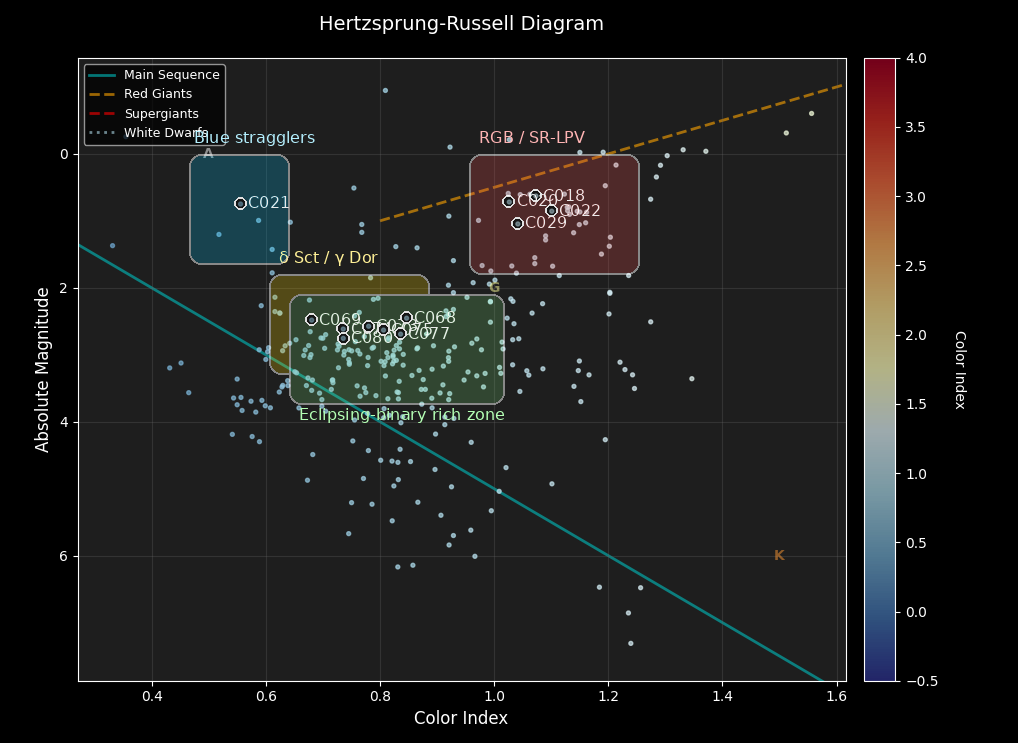
Fig. 4. The annotated diagram overlays several regions of interest for variable-star and peculiar-population studies. The light-blue area at upper left marks the Blue Straggler domain, containing stars hotter and more luminous than the cluster turn-off; the object labelled C021 falls in this region. The yellow band indicates an area where δ Scuti and γ Doradus pulsators may occur, while the green region covers part of the main sequence and turn-off that is particularly rich in binaries and possible eclipsing variables. The reddish area at upper right contains the red-giant branch and the region where semiregular or long-period variables may be expected. Labels C018, C020, C022, C029, C060, C068, C076 and C077 highlight sources selected for analysis. Position in a given region of the diagram is a useful scientific selection criterion, but is not sufficient by itself for a definitive classification: light curves, periodicities, amplitudes, reliable colours and, where available, spectroscopic data are required. The overlap of some regions also shows that different variability mechanisms may occupy similar photometric domains.
In this context, the contribution of non-professional observatories can be important. Photometric and astrometric observations made with amateur-class instruments can monitor variable stars over time, improve available datasets and contribute directly to scientific research. Collaboration between professional astronomers and experienced amateur observers is a practical example of participatory science that broadens both knowledge and discovery opportunities.
M67 is more than a cluster of stars: it is a window on the past of our Galaxy and, in some respects, on the future evolution of Sun-like stars. Observing it means exploring an old, stable and scientifically rich stellar population in which individual stars illustrate different stages of stellar evolution.
Author and credits
LS Associazione Astrofili Astris
Images and data processing: S04 Astronomical Observatory NS